For years, the Rolex GMT-Master II Ref. 16713 lived in the shadow of its all-steel siblings. Collectors chasing the “Pepsi” or “Coke” GMT-Master II usually overlooked the two-tone model, viewing it as the dressier alternative rather than the enthusiast’s choice.
That perception has changed. As interest in neo-vintage Rolex continues to grow, the 16713 has emerged as one of the most distinctive references in the GMT-Master II lineage—not because it’s rare, but because it offers qualities modern Rolex simply doesn’t manufacture anymore.
Produced from the late 1980s until the mid-2000s, the 16713 combines aluminum bezel inserts, slimmer case proportions, tritium-era character, and solid mechanical reliability in a package that feels unmistakably of its time. Rather than trying to replicate vintage aesthetics, it is a product of the transitional period between vintage Rolex and today’s ceramic-bezel generation.
Here’s why collectors continue to rediscover the reference.
Aluminum Bezels Develop Character That Ceramic Cannot
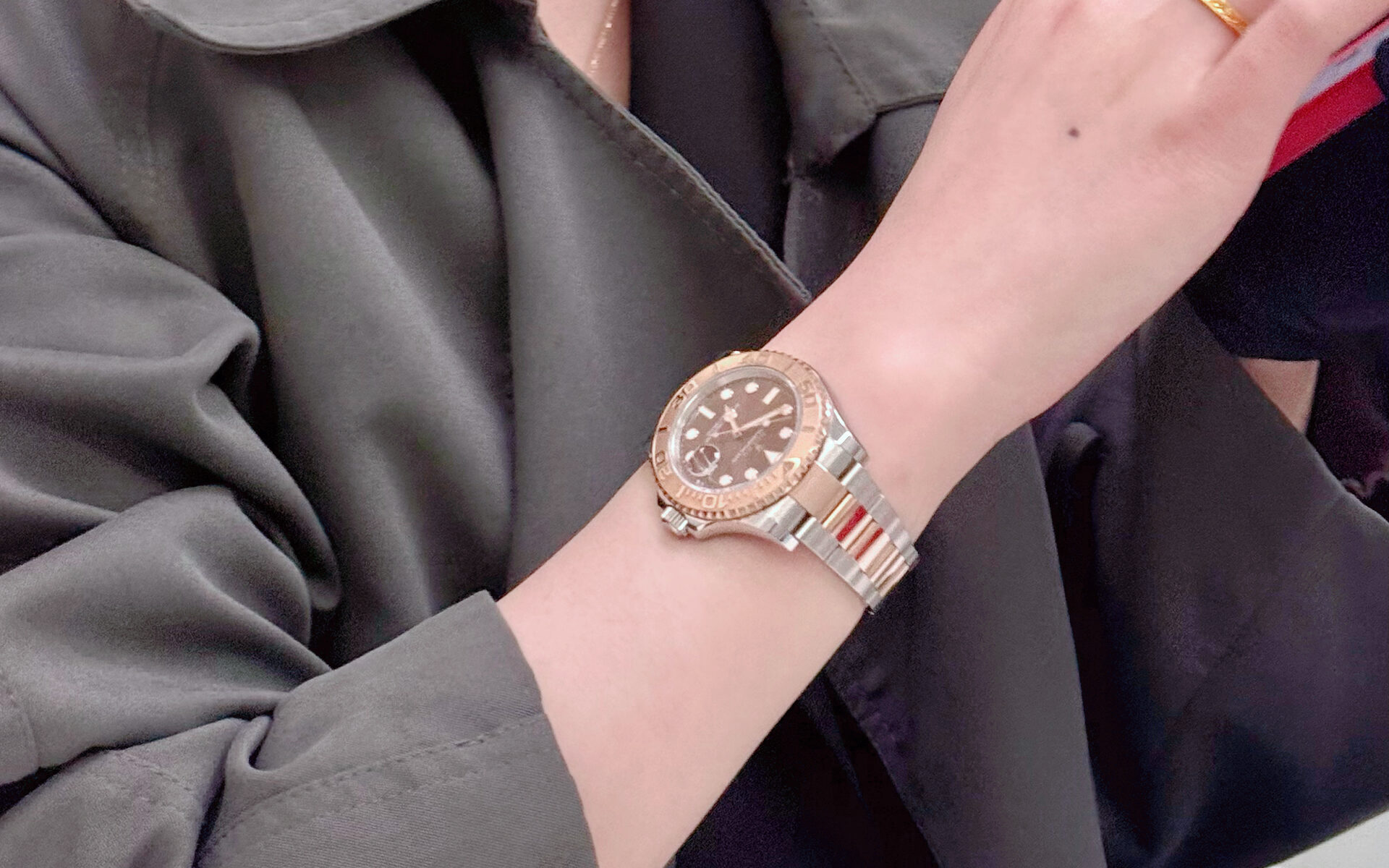
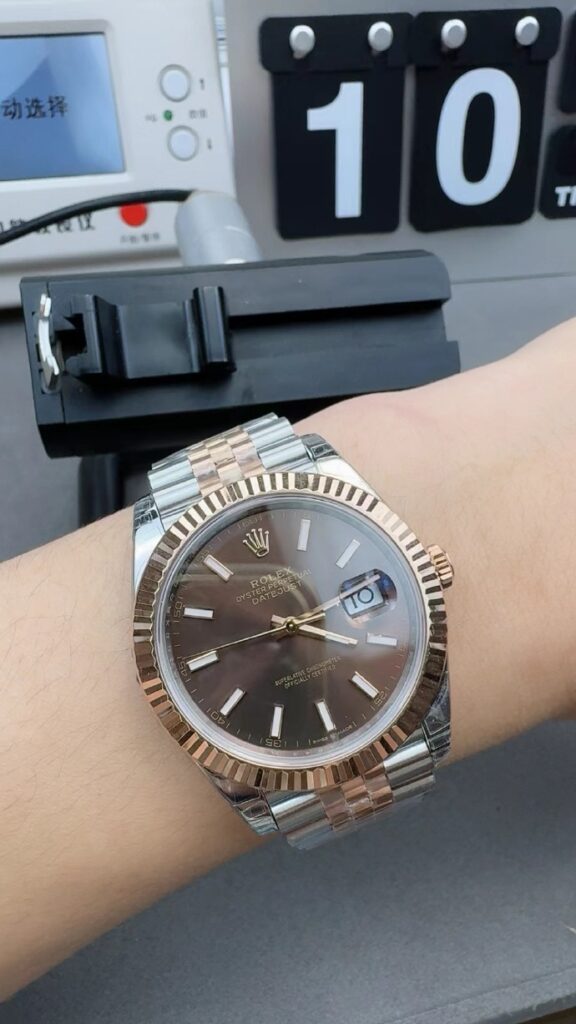
Close-up of a Rolex GMT-Master II Ref. 16713 showing its brown sunburst dial and two-tone aluminum bezel.
One of the defining features of the 16713 is its anodized aluminum bezel insert.
Modern Rolex GMT-Master II models use Cerachrom, a proprietary ceramic designed to resist scratches, fading, and UV damage. From a durability standpoint, it’s an outstanding material. A ceramic bezel should retain its original appearance for decades under normal wear.
Aluminum behaves differently.
Years of sunlight, daily wear, and environmental exposure gradually change its appearance. Brown inserts can soften into lighter caramel tones, gold numerals often lose some of their brightness, and heavily worn examples sometimes develop the muted “ghost” effect that collectors associate with well-traveled vintage Rolex watches.
These changes aren’t manufactured or predictable. Every watch ages according to how it has been worn, which means no two examples look exactly alike.
Whether that aging is desirable is ultimately a matter of taste. Some collectors prefer the permanence of ceramic, while others value the individuality that naturally develops on aluminum bezels. The recent interest in neo-vintage Rolex suggests the latter view has gained considerable momentum.
Dial Variations Reward Careful Collecting
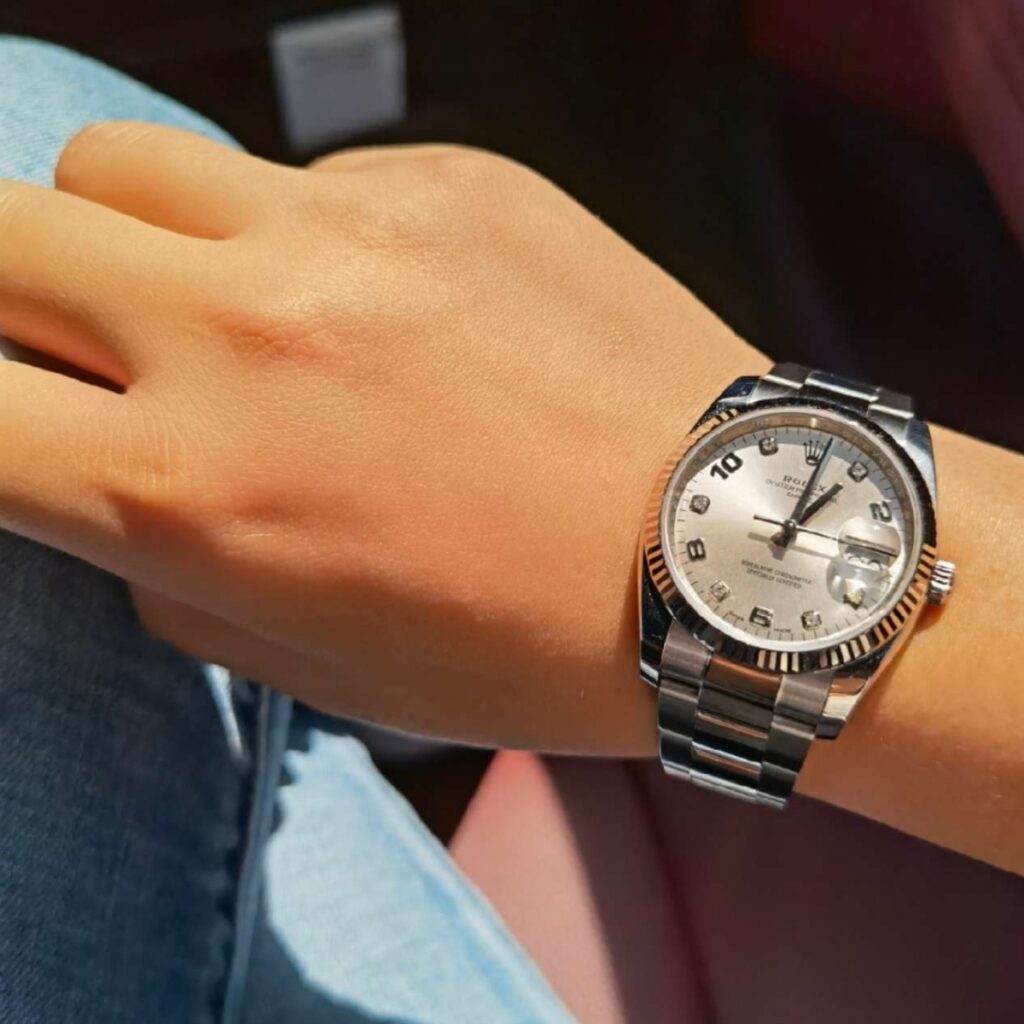
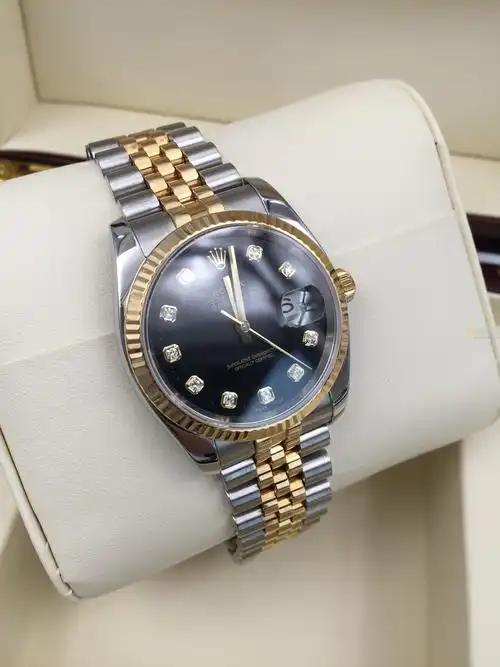
Rolex GMT-Master II Ref. 16713 with a factory Serti dial featuring diamond and ruby hour markers.
The 16713 remained in production for well over a decade, giving Rolex time to introduce several dial variations that have become collectible in their own right.
Early “Nipple” Dials
Some early examples inherited the raised gold hour markers found on the preceding GMT-Master Ref. 16753. Collectors commonly refer to these as “nipple dials” because of their rounded applied markers.
They reflect the bold design language of 1980s Rolex, pairing polished yellow gold accents with the warm tones of the two-tone case. While the nickname is informal, it has become standard terminology among vintage Rolex enthusiasts.
Factory Serti Dials
At the opposite end of the spectrum are factory Serti dials.
These feature diamond hour markers combined with sapphire or ruby accents set directly by Rolex. Available on slate, champagne, and other dial colors depending on production year, Serti dials represent one of the most luxurious interpretations of the GMT-Master II.
Their appeal has fluctuated over time. During the minimalist trends of the 2010s, they attracted a relatively niche audience. More recently, however, collectors have shown renewed interest in highly expressive 1980s and 1990s designs, helping factory Serti models regain attention.
That doesn’t necessarily mean every Serti dial will outperform standard dials financially. Condition, originality, provenance, and overall market demand remain far more important than any single configuration.
The Case Proportions Many Enthusiasts Still Prefer
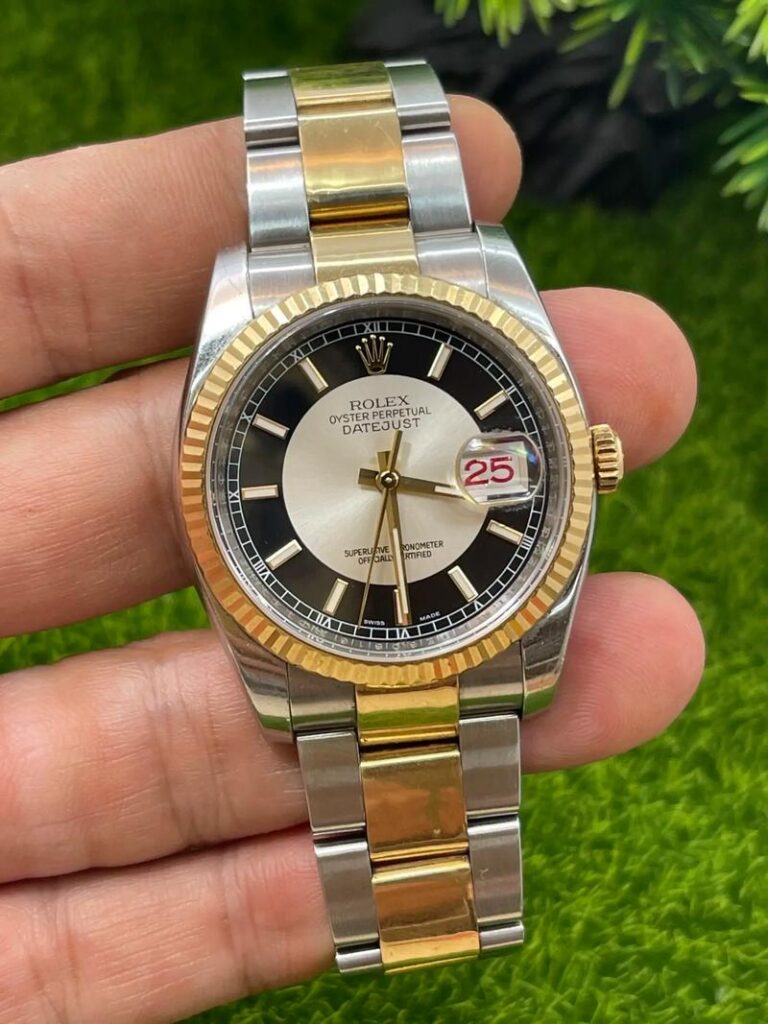
Rolex GMT-Master II Ref. 16713 on a two-tone Jubilee bracelet.
Although the official case diameter measures 40 mm, the 16713 wears noticeably differently from today’s GMT-Master II references.
The slimmer lugs, thinner crown guards, narrower bracelet profile, and lighter overall construction give the watch a more balanced feel on the wrist. It slips comfortably beneath a shirt cuff while retaining enough visual presence for casual wear.
Many collectors describe five-digit Rolex sports models as occupying a transitional sweet spot. They maintain much of the elegance associated with earlier references while incorporating practical improvements that make them easy to wear every day.
Mechanically, the 16713 is powered primarily by the replica Rolex Calibre 3185, introduced in the late 1980s. One of its defining features is the independently adjustable local hour hand, allowing travelers to change time zones without stopping the movement—a capability that remains central to the GMT-Master II today.
The movement has earned a strong reputation for durability and long-term serviceability, although, like any mechanical caliber, performance depends heavily on maintenance history rather than age alone.
Oyster or Jubilee? The Bracelet Changes the Personality
The bracelet plays a surprisingly large role in how the 16713 feels.
An Oyster bracelet emphasizes the GMT-Master II’s origins as a professional travel watch. Its three-link construction gives the watch a more purposeful appearance and pairs naturally with casual clothing.
The Jubilee bracelet creates a noticeably different impression.
Its five-link design reflects light more dramatically, softening the transition between steel and yellow gold and giving the watch a more refined presence. Combined with the warm brown dial found on many 16713 examples, the Jubilee can make the watch feel almost like vintage jewelry without sacrificing everyday practicality.
Neither bracelet is objectively better. Most collectors simply choose the version that best fits how they intend to wear the watch.
Why the 16713 Has Become More Noticeable in Today’s Market
Historically, collectors tended to prioritize stainless-steel GMT-Master II references such as the Ref. 16710, leaving two-tone models available at comparatively lower prices.
First, collectors have broadened their appreciation beyond steel sports watches, leading to renewed interest in two-tone Rolex references that were once considered unfashionable.
Second, neo-vintage watches have become increasingly attractive to buyers seeking slimmer cases, aluminum bezels, and tritium-era aesthetics without moving fully into vintage ownership.
Finally, the 16713 occupies an interesting position within the Rolex catalog. It offers genuine 18k yellow gold alongside many of the characteristics enthusiasts associate with classic five-digit references, yet it has often traded below comparable all-steel GMT-Master II models.
Whether that relationship continues will depend on broader market conditions. Like any collectible, prices fluctuate with supply, demand, and collector preferences, so future appreciation should never be treated as guaranteed.
For many buyers, the strongest argument for the 16713 isn’t investment potential—it’s that the watch offers a combination of materials, proportions, and aging characteristics that modern Rolex no longer produces.
Is the Rolex 16713 Right for You?
The 16713 appeals to a specific type of collector.
If you prefer modern ceramic bezels that remain virtually unchanged after years of wear, or you want the understated appearance of an all-steel sports watch, newer GMT-Master II references may suit you better.
Its aluminum bezel develops its own character over time. Its slimmer case reflects an era before modern Rolex proportions became more substantial. And its combination of steel, yellow gold, and warm dial colors gives it a personality that’s difficult to replicate elsewhere in the GMT-Master II family.
That’s ultimately why the reference continues to attract attention. It isn’t trying to be the newest GMT-Master II, nor the rarest. Instead, it represents a period when Rolex was blending vintage design language with the mechanical improvements that define the modern travel watch—a combination that many collectors now view as one of the brand’s most appealing eras.
If you’ve spent any time following the pre-owned watch market, you’ve probably noticed a recurring theme: many experienced collectors aren’t chasing the newest Rolex releases. Instead, they’re returning to references produced from the late 1980s through the early 2000s.
Known collectively as the five-digit Rolex generation, these watches occupy an unusual place in the brand’s history. They’re modern enough to wear every day yet old enough to retain many design traits that disappeared as Rolex moved toward contemporary manufacturing.
For buyers looking for a single watch that balances durability, character, and long-term collectability, five-digit references have become one of the most compelling areas of the Rolex catalog.
Why Five-Digit Rolex Models Still Stand Out
Rolex GMT-Master II Ref. 16710 with a naturally faded “Pepsi” aluminum bezel.
Five-digit references arrived during one of Rolex’s most significant periods of evolution. The company was modernizing its movements, improving water resistance, and introducing sapphire crystals across much of the professional lineup, while still retaining many visual characteristics associated with vintage Rolex.
The result is a generation of watches that feels transitional in the best possible way.
They Age Naturally
One of the biggest differences between five-digit Rolex models and current production references is the use of aluminum bezel inserts on sports watches such as the Submariner and GMT-Master II.
Unlike today’s ceramic bezels, aluminum gradually develops signs of wear. Colors soften, edges become smoother, and prolonged UV exposure can create subtle fading that varies from one watch to another.
Some collectors actively seek heavily faded examples, while others prefer watches that retain their original colors. Neither approach is inherently better, but both highlight something ceramic intentionally avoids: visible aging.
The Proportions Feel More Traditional
Rolex cases have evolved significantly over the past two decades.
Five-digit sports models generally feature slimmer lugs, narrower crown guards, and lighter bracelets than many of their modern successors. Although most still measure 40 mm in diameter, they often wear smaller because of their overall proportions.
For many enthusiasts, that translates into greater versatility. A five-digit Submariner or GMT-Master II can feel equally comfortable beneath a dress shirt cuff or with casual weekend clothing.
This preference is subjective—some buyers appreciate the more substantial presence of contemporary Rolex—but it explains why earlier references continue to attract dedicated followings.
Modern Enough for Everyday Wear
Despite their vintage appearance, most five-digit Rolex watches remain highly practical daily companions.
Compared with earlier four-digit references, they introduced several improvements that significantly reduced the compromises traditionally associated with vintage ownership.
These include:
- Scratch-resistant sapphire crystals instead of acrylic.
- Improved automatic movements with proven long-term reliability.
- Strong water resistance suitable for normal daily use, provided the watch has been properly maintained.
- Excellent parts availability through experienced independent watchmakers and Rolex service channels, although availability can vary by reference and region.
For many buyers, this combination is what makes five-digit Rolex models so appealing. They deliver much of the charm associated with vintage collecting without requiring the same level of caution or specialized ownership.
Five References That Define the Era
While Rolex produced numerous five-digit references, a handful have become benchmarks for collectors.
Rolex Submariner Date Ref. 16610
Rolex Submariner Date Ref. 16610 with black aluminum bezel and classic Oyster bracelet.
Few watches have influenced modern dive watch design more than the Submariner 16610.
Produced from 1988 until 2010, it represents the final generation of the classic aluminum-bezel Submariner before Rolex introduced ceramic bezels and redesigned case proportions.
Powered by the Calibre 3135, the 16610 earned a reputation for exceptional durability and serviceability. Many examples remain in regular use decades after leaving the factory.
Compared with the current Submariner Date, the slimmer case profile gives the 16610 a lighter, more balanced feel. Combined with its aluminum bezel and aging lume—whether tritium on earlier examples or Luminova on later production—the watch has developed a distinctive personality that many collectors feel newer references cannot replicate.
Specifications
| Feature | Details |
|---|---|
| Case size | 40 mm |
| Movement | Rolex Calibre 3135 |
| Production | 1988–2010 |
Rolex GMT-Master II Ref. 16710
The GMT-Master II Ref. 16710 is often regarded as one of the defining travel watches of the modern era.
Its appeal extends well beyond the famous “Pepsi” bezel.
Rolex produced the reference with red-and-blue (“Pepsi”), red-and-black (“Coke”), and all-black bezel inserts, giving buyers several distinct personalities within the same platform. Over time, many aluminum inserts have faded into softer shades of blue, pink, charcoal, or grey, making each watch visually unique.
Mechanically, the watch introduced the independently adjustable local hour hand through the Calibre 3185, simplifying travel across multiple time zones. Late-production examples received the updated Calibre 3186, which incorporated several technical refinements, including Rolex’s Parachrom hairspring.
Collectors continue to debate which movement is more desirable, but both have established long records of dependable performance.
Specifications
| Feature | Details |
|---|---|
| Case size | 40 mm |
| Movement | Calibre 3185 (later 3186) |
| Production | 1989–2007 |
Rolex Explorer II Ref. 16570
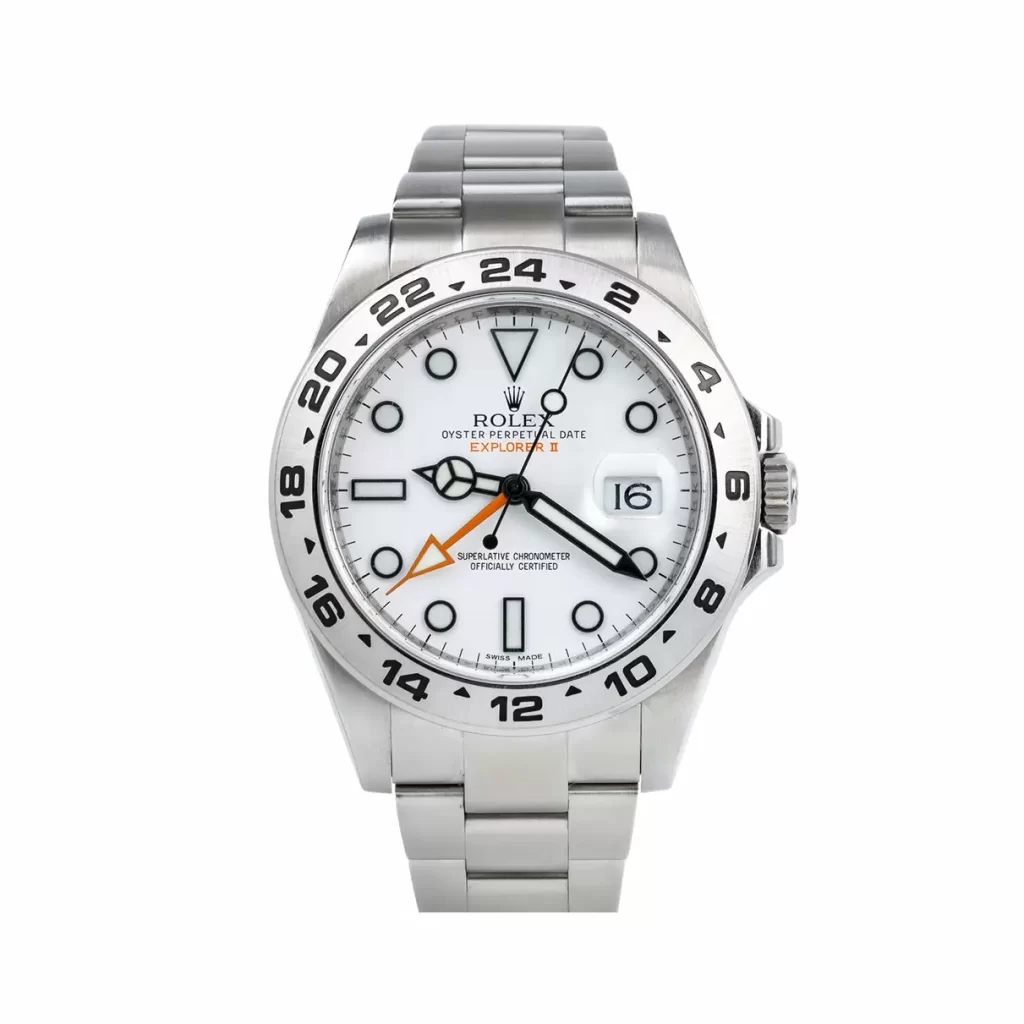
Rolex Explorer II Ref. 16570 with Polar white dial.
For years, the Explorer II lived quietly outside the spotlight.
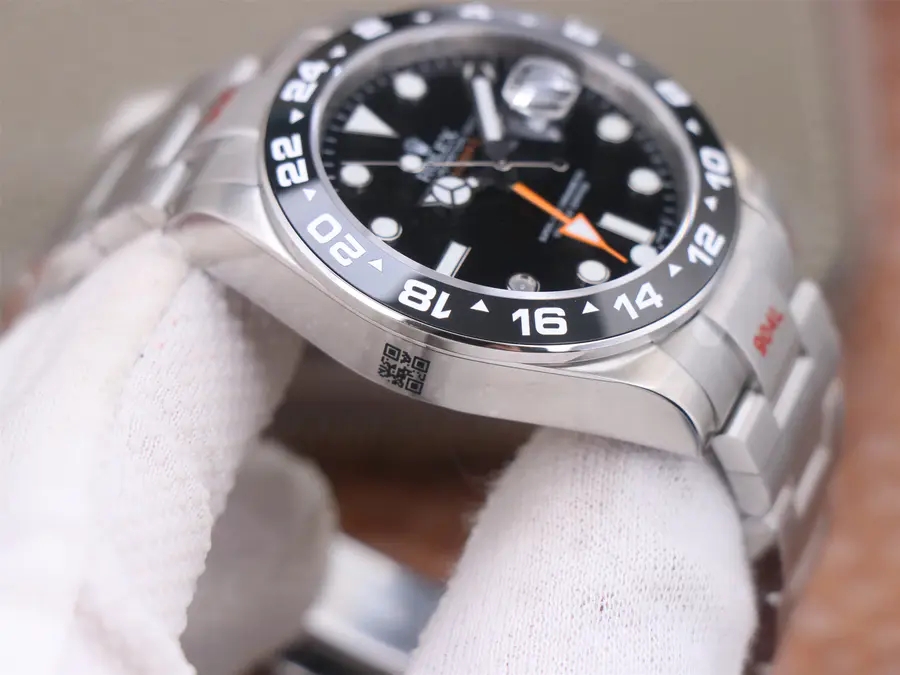
The Ref. 16570 has become increasingly popular among collectors who appreciate its understated design and practical functionality. Unlike the GMT-Master II, it uses a fixed steel 24-hour bezel, giving the watch a cleaner, more restrained appearance.
Buyers generally choose between two distinct personalities.
The black dial offers maximum subtlety, while the white “Polar” dial creates striking contrast against the black hour-marker surrounds and bright red GMT hand. The Polar version has become particularly sought after in recent years, although preference ultimately comes down to personal taste.
For collectors who want a fake Rolex sports watch that feels less ubiquitous than the Submariner or GMT-Master II, the 16570 remains one of the strongest candidates.
Specifications
| Feature | Details |
|---|---|
| Case size | 40 mm |
| Movement | Calibre 3185 (later 3186) |
| Production | 1989–2011 |
Rolex Submariner Ref. 14060
Rolex Submariner Ref. 14060 with its clean no-date dial.
Among Rolex enthusiasts, the no-date Submariner often inspires particularly strong loyalty.
Without the Cyclops magnifier or date window, the dial achieves near-perfect symmetry, emphasizing the simple geometry that has defined the Submariner for decades.
The early Ref. 14060 also retained several vintage characteristics, including drilled lug holes that make bracelet removal easier and a minimalist two-line dial that many collectors consider one of the cleanest designs Rolex has ever produced.
Its Calibre 3000 lacks some later technical upgrades, but it has earned an excellent reputation for reliability when properly serviced.
Specifications
| Feature | Details |
|---|---|
| Case size | 40 mm |
| Movement | Calibre 3000 |
| Production | 1990–1998 (14060M until 2012) |
Rolex Explorer Ref. 14270
Rolex Explorer Ref. 14270 with glossy black dial and white-gold 3-6-9 numerals.
The Explorer 14270 demonstrates that restraint can be just as compelling as complexity.
Released in 1989, it modernized the classic Explorer by introducing a sapphire crystal, glossy dial, and white-gold surrounds around the signature 3-6-9 numerals while preserving the model’s understated identity.
At 36 mm, it wears noticeably smaller than today’s sports watches, but that size is precisely what many collectors appreciate. It remains comfortable on a wide range of wrists and transitions effortlessly between formal and casual settings.
Rather than drawing attention, the Explorer rewards long-term ownership through balance, proportion, and everyday usability.
Specifications
| Feature | Details |
|---|---|
| Case size | 36 mm |
| Movement | Calibre 3000 |
| Production | 1989–2001 |
Why Collectors Continue to Choose Five-Digit Rolex
Five-digit Rolex references aren’t simply older versions of today’s watches.
They represent a distinct chapter in Rolex history—one in which traditional proportions, naturally aging materials, and increasingly sophisticated engineering came together before the brand shifted toward the design language that defines its modern catalog.
That combination explains why demand has remained resilient even as newer references have entered the market.
For buyers who value individuality over factory perfection, these watches offer something increasingly difficult to find: the opportunity to own a Rolex that gradually reflects its own history through years of wear, while still delivering the reliability expected from a modern mechanical watch.
Choosing between the Rolex GMT-Master II “Batman” and the newer “Bruce Wayne” isn’t really about specifications. Mechanically, the two watches are almost identical. The real decision comes down to how you want the watch to look, wear, and fit into your collection.
Both models belong to the current GMT-Master II family, both use Rolex’s latest-generation movement, and both offer the same travel functionality. The differences are almost entirely visual—but those visual differences create two watches with very different personalities.
The Specifications Are Nearly Identical
From a technical standpoint, Rolex treats these references as variations of the same platform.
| Feature | Batman (Ref. 126710BLNR) | Bruce Wayne (Ref. 126710GRNR) |
|---|---|---|
| Bezel | Blue and black Cerachrom | Grey and black Cerachrom |
| GMT Hand | Blue | Green |
| Dial Text | White | Green |
| Case | 40 mm Oystersteel | 40 mm Oystersteel |
| Movement | Calibre 3285 | Calibre 3285 |
| Power Reserve | Approximately 70 hours | Approximately 70 hours |
| Water Resistance | 100 m | 100 m |
| Bracelet | Oyster or Jubilee | Oyster or Jubilee |
Both references use Rolex’s Calibre 3285, which features an independently adjustable local hour hand, Chronergy escapement, Parachrom hairspring, and approximately 70 hours of power reserve. The movement has become the standard across Rolex’s current GMT-Master II lineup and has established a strong reputation for reliability since its introduction.
In practical use, you shouldn’t expect either watch to outperform the other.
The Batman Prioritizes Contrast and Recognition
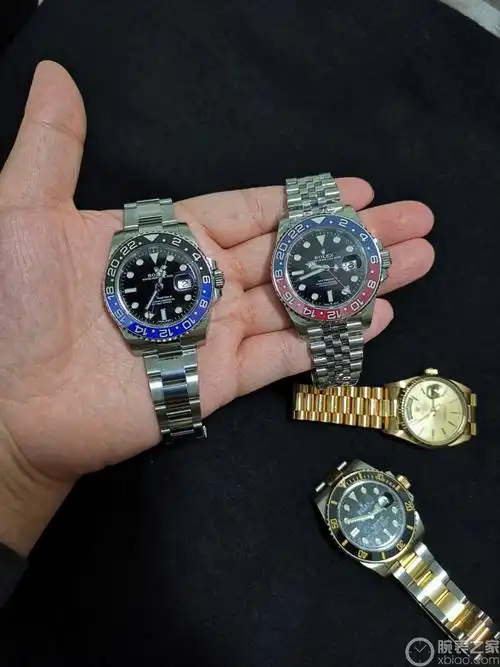
Rolex GMT-Master II Ref. 126710BLNR (“Batman”) with blue-and-black ceramic bezel.
Introduced in 2013, the Batman marked an important milestone for Rolex.
It was the first GMT-Master II to feature a two-color Cerachrom bezel, demonstrating that Rolex had solved a manufacturing challenge many believed wasn’t commercially practical. Producing two distinct ceramic colors within a single monobloc bezel insert required years of development, making the release significant from both a technical and design perspective.
Visually, the Batman remains one of the most recognizable Rolex sports watches.
The blue lower half of the bezel represents daytime hours, while the black upper half represents nighttime. The matching blue GMT hand ties the design together, giving the watch considerably more visual energy than most GMT-Master II references.
That boldness is precisely why many collectors are drawn to it.
The Batman rarely goes unnoticed, whether by watch enthusiasts or casual observers. If you enjoy wearing a replica Rolex with an immediately recognizable identity, it’s difficult to find another modern GMT that makes a stronger first impression.
The downside, depending on your perspective, is that its popularity also makes it one of the easiest Rolex sports watches to recognize.
The Bruce Wayne Takes a More Restrained Approach
Rolex GMT-Master II Ref. 126710GRNR (“Bruce Wayne”) with grey-and-black ceramic bezel.
Released in 2024, the Ref. 126710GRNR quickly acquired the nickname “Bruce Wayne” from collectors, continuing the community’s tradition of assigning unofficial names to GMT-Master II references.
Unlike “Batman” or “Pepsi,” however, “Bruce Wayne” wasn’t a nickname Rolex created or officially recognizes.
The watch replaces blue with grey, producing a much more understated appearance.
In many lighting conditions, the bezel appears almost entirely black. The grey half becomes obvious only under brighter light, giving the watch a subtlety that distinguishes it from every other ceramic GMT currently in production.
Instead of the Batman’s blue GMT hand, the Bruce Wayne uses green, along with matching green “GMT-Master II” dial text. These details provide just enough contrast without dominating the overall design.
The result is arguably the most conservative modern GMT-Master II Rolex currently produces.
For collectors who want one luxury watch capable of moving comfortably between business attire, travel, and casual wear, that’s a significant advantage.
Oyster or Jubilee? The Bracelet Makes a Bigger Difference Than You Might Expect
Both references are available on either an Oyster or Jubilee bracelet.
Mechanically, there’s no difference between the two. The decision comes down entirely to appearance and wearing experience.
Oyster Bracelet
The Oyster bracelet reinforces the GMT-Master II’s tool-watch heritage.
Its three-link construction creates a cleaner, sportier profile and emphasizes the watch’s origins as a travel instrument rather than a piece of jewelry. If your wardrobe is predominantly casual or you simply prefer understated design, the Oyster bracelet is often the more natural choice.
Jubilee Bracelet
The Jubilee gives the GMT-Master II an entirely different character.
Its five-link construction reflects considerably more light, making the watch feel more refined and visually expressive. Despite its dressier appearance, many owners also find the smaller links exceptionally comfortable during extended wear.
The Batman on a Jubilee bracelet became widely known among enthusiasts as the “Batgirl,” although Rolex has never used that nickname officially.
Interestingly, the Bruce Wayne hasn’t developed an equivalent nickname. Collectors generally describe it simply as the Bruce Wayne on Oyster or Bruce Wayne on Jubilee.
Which One Holds Value Better?
Market prices fluctuate continually, particularly for highly sought-after Rolex sports models.
Historically, newly introduced GMT-Master II references often command a premium over established models because supply is limited during the early years of production. As availability gradually improves, those premiums frequently moderate, although there is no guarantee that every reference follows the same pattern.
After more than a decade on the market, secondary-market pricing has become relatively stable compared with its earliest years.
The Bruce Wayne, by contrast, remains newer and therefore reflects stronger demand relative to available supply. Whether that premium persists will depend on future production levels, collector sentiment, and broader market conditions.
Anyone purchasing primarily for investment should remember that luxury watches are collectible assets rather than predictable financial instruments. Long-term values can appreciate, stagnate, or decline depending on economic conditions and changing collector preferences.
Buying the watch you genuinely prefer is generally a more reliable strategy than trying to predict short-term price movements.
Which GMT-Master II Fits Your Collection?
The better choice depends less on specifications than on what already exists in your watch box.
Choose the Batman if:
- You enjoy bold, easily recognizable sports watches.
- Most of your collection consists of black-dial models and you’re looking for something with more visual contrast.
- You appreciate the historical significance of Rolex’s first two-color ceramic bezel.
Choose the Bruce Wayne if:
- You prefer understated design over immediate recognition.
- You want a GMT-Master II that pairs as comfortably with business attire as it does with casual clothing.
- You value versatility more than distinctive color.
The Batman celebrates one of Rolex’s most recognizable modern designs, while the Bruce Wayne demonstrates how subtle changes in color can produce an entirely different personality without altering the underlying watch.